

Topical authority has always mattered in SEO. But after Google’s March 2026 core update, the way it’s evaluated has changed significantly, and most content strategies haven’t caught up.
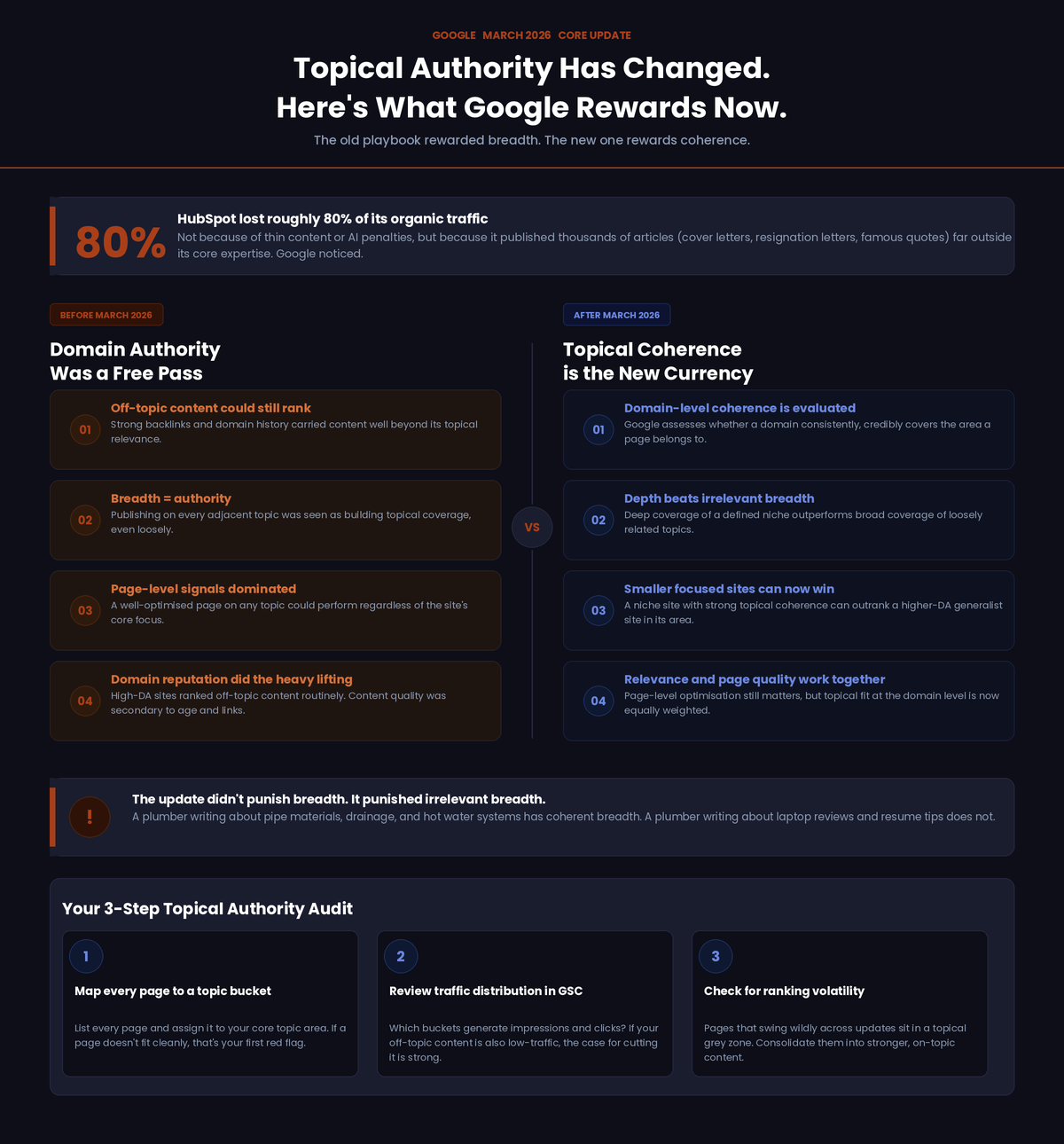
HubSpot lost approximately 75-80% of its organic traffic over two years. The reason wasn’t thin content, technical errors, or AI penalties. It was that they published thousands of articles on topics that had nothing to do with their core expertise: cover letters, resignation letters, famous quotes, and career advice. Google’s algorithm got better at recognising when a site was publishing outside its lane, and it started devaluing that content accordingly. The March 2026 core update formalised this shift. Topical authority now operates at the domain level, not just the page level, and the rules have changed for everyone.
What Actually Happened to HubSpot?
HubSpot built one of the most impressive content machines in marketing history. At its peak, the blog received over 13 million visits per month. The strategy was simple: publish on any topic adjacent to marketing, sales, or business, and capture search traffic at scale.
For years, it worked. Domain authority was strong enough to rank almost anything.
Then Google got smarter about what ‘relevant’ really means. By late 2024, HubSpot’s blog subdomain had shrunk from 77% of their total organic traffic to just 42%. Searches like ‘famous sales quotes’ and ‘how to write a cover letter’ stopped sending traffic to HubSpot because Google no longer considered HubSpot an authoritative source for those topics.
The traffic didn’t disappear. It went to sites that were actually in those verticals.
What Did Topical Authority Used to Mean?
The traditional playbook said: build a topic cluster. Write a pillar page on a broad topic, then create supporting cluster content around subtopics, all internally linked. Cover enough ground and Google would recognise you as an authority.
For many sites, that still holds. The cluster model is sound architecture.
But ‘topical authority’ in this model was often interpreted too broadly. Agencies and in-house teams used it as permission to expand into any loosely connected topic area. ‘We’re a marketing platform, so cover letters are fair game.’ ‘We’re a business tool, so workplace culture articles count.’
Google’s weighting at the time meant domain-level authority could carry off-topic content quite far in the rankings. A site with strong backlinks and a long publishing history could rank for almost anything, regardless of whether the topic genuinely matched its expertise. If you’ve seen similar dips in your own analytics, our post on zero-click searches and organic traffic loss gives more context on the broader traffic landscape right now.
That buffer has been significantly reduced.
What Does Topical Authority Mean in 2026?
After the March 2026 core update, Google has effectively separated page-level ranking signals from domain-level reputation. A high-authority domain can no longer carry content that sits outside its established topical territory.
Google is now evaluating topical coherence at the domain level. This builds on signals introduced as far back as the February 2026 Discover core update, which explicitly targeted sites that publish outside their area of expertise. The question isn’t just ‘is this page good?’ It’s: ‘Does this domain have consistent, deep, credible coverage of the area this page belongs to?’
For sites with tightly defined niches, this is excellent news. A small, focused site that deeply covers one topic area can now outrank a generalist site that’s been around longer, has more backlinks, and has published far more content, as long as its topical coherence is stronger.
For sites that have expanded aggressively into adjacent or unrelated topics, the exposure is real. Content that used to rank on the back of domain authority now needs to stand on its own topical merit.
The Difference Between Breadth and Depth
This is the nuance that most analyses of the March 2026 update have missed.
The update didn’t punish breadth. It punished irrelevant breadth.
A plumbing company that writes about pipe materials, water pressure, drain maintenance, hot water systems, and emergency repairs has breadth within a cohesive topic area. That’s what Google is rewarding.
A plumbing company that also writes about the best laptops for small businesses, how to write a resume, and celebrity net worths has incoherent breadth. That’s what Google is now actively discounting.
The line isn’t always perfectly clear. A marketing software company writing about management and leadership is debatable. A marketing software company writing about cover letter formats is not.
The practical test is this: if someone came to your site specifically because of your core expertise, would this article make sense for them to find here? If the answer is ‘probably not,’ that content may be quietly dragging down the topical coherence signals for your whole site.
What Does This Mean for AI Search?
The topical authority shift doesn’t only affect traditional Google rankings. AI systems, including Google AI Overviews, Perplexity, and ChatGPT Search, also favour sources that demonstrate deep, coherent expertise on a topic. A site with strong topical authority is more likely to be cited as a trusted source in AI-generated answers. We’ve covered the mechanics of this in more detail in our post on getting cited in AI search, but the short version is: the signals that help you rank in traditional search are increasingly the same signals that get you cited in AI search.
If you’re new to the distinction between traditional SEO and AI optimisation, our SEO vs GEO explainer is a good place to start.
What Should You Actually Do About It?
This isn’t a call to delete half your blog. It’s a call to audit it honestly.
Start by reviewing your existing content with a single question: does this article belong on a site that’s known for our core topic area? If large sections of your blog are off-topic relative to your business’s actual expertise, you have a few options:
- Consolidate off-topic content into a stronger, more relevant piece.
- Noindex content that doesn’t serve your SEO goals or drive meaningful conversions.
- Update off-topic articles to bridge them back to your core subject matter where that genuinely makes sense.
- Leave older, low-traffic off-topic content for now, monitor it, and make decisions based on real data.
For new content, the answer is simpler: before publishing anything, ask whether it reinforces or dilutes your topical territory. If a topic is valuable but genuinely outside your lane, consider whether it belongs on your site, a separate brand, or not at all.
At GEOSEO Digital, we’ve seen clients get significantly better results by tightening their content focus. Less content, more coherence. Not always an easy sell, but the March 2026 data makes the argument for us.
How to Audit Your Own Topical Authority
Here’s a simple framework we use with our clients.
Step 1: Map every page to a topic bucket.
List every page on your site and assign it to a core topic area that reflects your actual business expertise. If you can’t easily assign a page to a relevant bucket, that’s your first signal.
Step 2: Review traffic distribution in Google Search Console.
Which topic buckets are generating impressions and clicks? Which are flat? If your off-topic content is also your lowest-traffic content, the case for consolidating or cutting it is strong.
Step 3: Check for ranking volatility.
Pages that fluctuate wildly across core updates are often sitting in a topical grey zone: good enough to rank sometimes, but not coherent enough to hold position. Google’s own guidance on core updates recommends consolidating weaker pages into stronger content rather than trying to optimise individual pages in isolation.
The Takeaway
The topical authority playbook hasn’t been thrown out. It’s been refined. The cluster model still works. Publishing consistently in your area of expertise still works. What doesn’t work anymore is using domain authority as a substitute for genuine topical relevance.
If HubSpot, with all its brand equity and publishing history, can lose 80% of its traffic by drifting off-topic, smaller sites with thinner authority margins face the same risk with less cushion to absorb it.
Get clear on what your site is for. Publish deeply within that lane. And let Google’s improved understanding of topical coherence work in your favour, not against it.
Not sure where your site stands? Get in touch with GEOSEO Digital and we’ll take a look. A focused content audit is often the fastest way to find where you’re leaving rankings on the table.
Frequently Asked Questions
Does this mean I should delete all my off-topic content?
Not necessarily. Deletion is one option but not always the right one. A better approach is to audit your content, identify what’s genuinely off-topic, and decide case by case whether to consolidate, noindex, update, or leave it. Deleting pages removes internal link equity, so approach it carefully rather than in bulk.
Has Google confirmed that topical coherence is a ranking signal?
Google hasn’t published a ranked list of signals, but the March 2026 core update guidance, Google’s helpful content system documentation, and the documented outcomes for sites like HubSpot all point clearly in the same direction. Topical coherence at the domain level is the pattern the data consistently supports.
Can a newer site compete with older, high-authority sites using this approach?
Yes, more so than before. Tight topical focus is one of the most accessible advantages available to newer or smaller sites. A site that deeply covers a specific niche with consistent, quality content can outperform older generalist sites in that niche, even with a fraction of the backlink profile.
How is topical authority different from domain authority?
Domain authority is a broad measure of a site’s backlink profile and ranking power, calculated by tools like Ahrefs and Moz. Topical authority is about how comprehensively and credibly your site covers a specific subject area. After March 2026, Google is weighting topical authority more heavily relative to general domain authority. A weaker DA site with strong topical coherence can now outrank a stronger DA site that’s publishing off-topic.
How long does it take to see results from improving topical authority?
Google recrawls and reindexes content continuously, but meaningful ranking shifts from a content audit typically take one to three months to appear. Core update improvements are assessed at the next update cycle, which Google usually runs every few months. Expect gradual, compounding improvement rather than an overnight change.