

Short answer: yes, if people search for what your service costs. Publishing real numbers is how you get into the answer when someone asks that question. Just don’t expect it to send you much traffic.
That sounds like a contradiction. It isn’t, and the reason matters more than the decision itself.
This post covers why cost questions behave differently to every other search, what happened when one of our clients published a pricing table, and how to put numbers on your site without handing your competitors a price list.
Why Is the Cost Question Different From Every Other Search?
“How much does gutter cleaning cost” looks like a buying question. To Google, it reads as an information question.
That distinction decides what the results page looks like. Seer Interactive’s April 2026 analysis of 53 brands, 5.47 million tracked queries and 2.43 billion organic impressions found AI Overviews on 36% of informational queries, but only 8% of commercial ones and 5% of transactional ones.
Cost questions sit in both camps. They’re phrased like research and asked by people about to spend money.
Whitespark tested this for local businesses specifically. Across 540 manual searches covering three cities and six industries, hybrid-intent queries like “average cost of dental implants in Phoenix” returned an AI Overview 97% of the time. Straight local searches returned one just 15% of the time. That study ran in May 2025 and it’s a small sample, so treat the exact numbers as directional. The gap is too wide to be noise.
So the cost question is the one search where an AI answer is close to guaranteed.
If you haven’t published a number, the answer still gets written. It just gets built from someone who has. Usually a directory, a competitor, or a national average that’s nowhere near what you’d charge in your suburb.
What Happened When One Client Published Its Prices?
We work with a Melbourne home services business whose cost page had been live for years. It talked around pricing without ever giving a figure.
In May 2026 we rebuilt it with a real pricing table. Actual dollar ranges, broken down by property type, with the variables that move the price named openly.
Six months of Search Console data later, here’s where its pricing queries had moved.
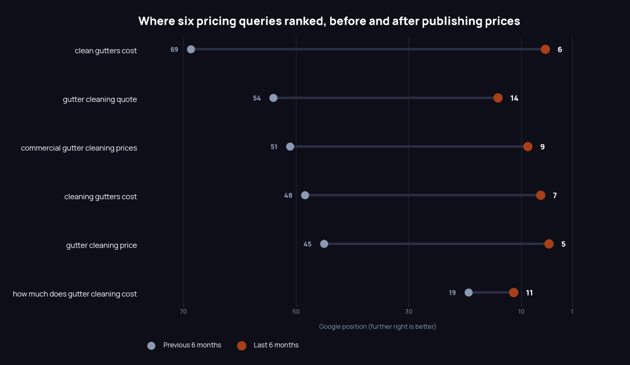
One query went from position 45 to position 5. Another from 69 to 6. Across the whole set, 461 of the 556 pricing queries with comparable data improved their position. That’s 83%.
Click-through rate on that group of queries nearly doubled, from 0.41% to 0.77%.
So publishing prices worked. Then it ran into something else.
Why Didn’t Better Rankings Produce More Traffic?
Here’s the same page’s best pricing queries, with what those rankings actually delivered.
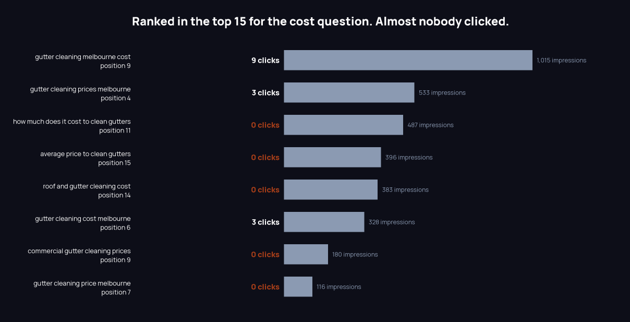
Position 4. Position 6. Position 7. Hundreds of impressions each. Several with no clicks at all.
This isn’t a quirk of one client. Ahrefs compared 300,000 keywords using aggregated Search Console data and found that when an AI Overview is present, top-ranking pages see 58% lower click-through rate. Their earlier measurement put that figure at 34.5%. It’s getting worse, quickly.
There’s a second finding that matters more. Ahrefs also analysed 863,000 keyword SERPs and four million AI Overview URLs in March 2026. Only 38% of AI Overview citations came from pages ranking in the top 10. In July 2025 that number was around 76%.
Read that again. In twelve months, the link between ranking on page one and being quoted in the AI answer roughly halved.
Ranking for the cost question and being the source the answer is built from are now two different achievements. You can have one without the other.
So Why Publish Prices At All?
Because being the cited source is worth far more than ranking near it.
Seer’s data puts a number on the gap. Being cited in an AI Overview delivers 120% more organic clicks per impression than appearing on the same page and not being cited. When an AI Overview appeared and the brand wasn’t cited, click-through rates fell 67% over 2025.
That’s the real choice. Not whether to chase the click, but whether to be in the answer that’s taking it.
Our client’s own data shows what that looks like.
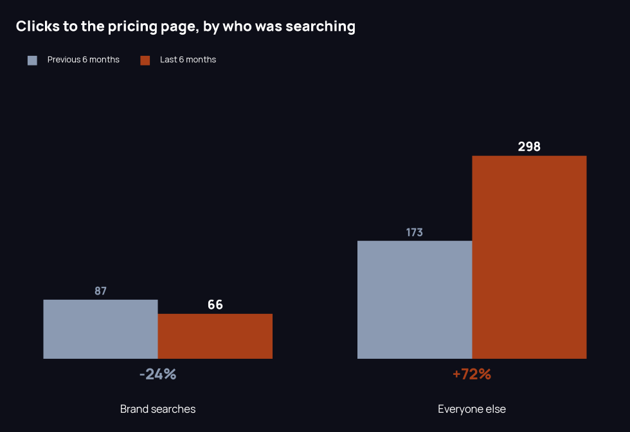
Clicks from people searching the business by name fell 24%. Clicks from everyone else rose 72%.
We checked whether brand demand had simply moved elsewhere on the site. It hadn’t. Brand searches across the whole domain were flat over the same period, down 3%. Every bit of the growth came from people who didn’t know this business existed.
How Do You Publish Prices Without Getting Undercut?
The objection is always the same. Publish your prices and your competitor undercuts you by twenty dollars.
Fair. Here’s how to handle it.
- Publish ranges, not a single figure. “$320 to $420 for a standard clean” is quotable and still leaves you room.
- Name the variables that move the price. Storey height, roof type, access, urgency. This is what turns a number into an answer rather than a quote.
- Put the number near the top. AI systems extract at sentence and paragraph level. If the figure is buried in paragraph nine, it’s harder to lift.
- Use a real HTML table, not an image of one. Screen readers can’t read a table saved as a picture, and neither can an AI system.
- Date it and keep it current. Perplexity weights freshness heavily, and citation rates fall away for content left untouched past about three months.
One thing you don’t need: a special file or markup to make this work. Google’s own AI optimisation guide states that structured data isn’t required for generative AI search and there’s no special schema you need to add. Write the page for the person reading it.
The Takeaway
Publishing your prices won’t flood your site with traffic. On our client’s page, six months of genuine ranking improvement produced clicks that stayed nearly flat on some of the best queries.
What it does is put you in the conversation. The cost question gets answered whether you take part or not. Publishing real numbers is how you make sure the answer is built from your figures rather than someone else’s guess.
You’re not deciding whether people discuss your pricing. You’re deciding whether you’re in the room when they do.
Ready to Find Out If AI Is Quoting You or Your Competitor?
We’ll check which AI systems mention your business, what they’re saying about your pricing, and where the answer is coming from instead of you. Book a free GEO and SEO audit and we’ll walk you through it.
FAQs About Putting Prices on Your Website
Should you put prices on your website?
Yes, if customers search for what your service costs. Cost questions trigger AI-generated answers far more often than other local searches, and those answers get built from businesses that publish figures. Without a number on your site, the answer is assembled from directories, competitors, or national averages that don’t reflect your market.
Will publishing prices increase my website traffic?
Usually not by much. In our client data, publishing a pricing table lifted 83% of pricing queries in the rankings, but clicks stayed flat on several of the best-performing terms. Ahrefs found top-ranking pages lose 58% of their click-through rate when an AI Overview appears. Visibility improves more than traffic does.
Won’t my competitors just undercut my prices?
They can already find your pricing by requesting a quote. Publishing ranges rather than fixed figures protects your margin while still giving AI systems something to quote. Name the variables that move the price, like access or property size, so the number reads as a genuine answer rather than a fixed offer.
Do I need schema markup to get cited by AI?
No. Google states plainly that structured data isn’t required for generative AI search and there’s no special schema you need to add. Schema is still worth implementing for traditional rich results and entity clarity, but it isn’t the lever that gets you quoted. Clear, extractable content is.
How quickly do pricing pages get picked up by AI search?
Google can re-crawl and reassess a page within weeks. Perplexity, which crawls in real time and weights freshness heavily, can reflect changes within days. Our client’s pricing table went live in May 2026 and was holding position 1 AI Overview placements on four pricing queries by the end of that month.