

Something has quietly shifted in how people find local businesses.
Instead of typing “electrician Sydney” into Google and scrolling through a list of links, more Australians are opening ChatGPT, Perplexity, or Google’s AI search and asking: “Who’s a reliable electrician in the Inner West that can come this weekend?”
That one sentence contains intent, location, urgency, and a service request. And the AI doesn’t hand them ten websites to browse. It gives them a direct answer, usually naming one or two businesses it considers credible.
If your business isn’t one of them, you’re invisible. They never clicked away. They just never saw you.
This is the shift that Generative Engine Optimisation, or GEO, is designed to address. And for local and service-based businesses, it’s one of the most important things to understand right now.
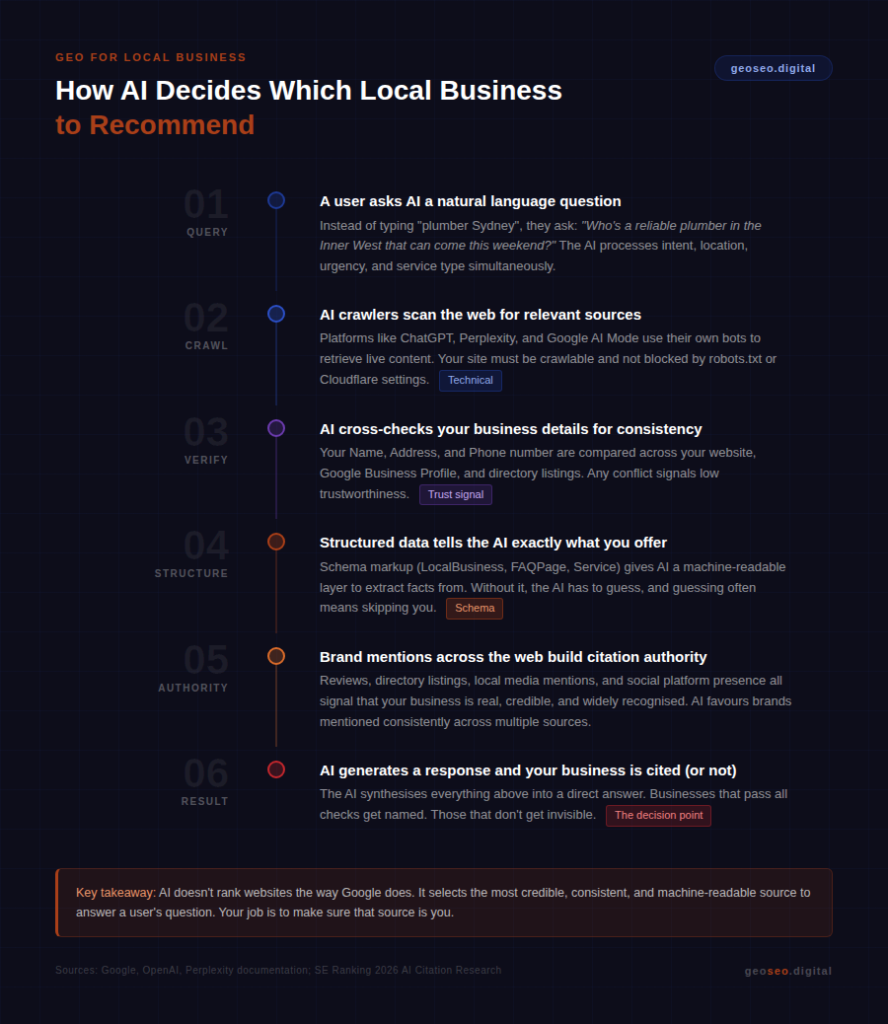
What is GEO and Why Does It Matter for Local Businesses?
GEO stands for Generative Engine Optimisation. It’s the practice of optimising your online presence so that AI-powered platforms cite, recommend, or name your business when users ask relevant questions.
Traditional SEO helps your website rank in Google search results. GEO builds on those same foundations to make your brand visible inside AI-generated answers, across platforms like ChatGPT, Perplexity, Google AI Overviews, Google AI Mode, and Gemini.
The key difference is the outcome. With traditional SEO, the goal is a click. With GEO, the goal is a citation. The user may never visit your website at all, but AI has already spoken your name to them as the recommended option.
For local and service businesses, this is particularly significant.
When someone asks AI for the best tradie, the best dentist, or the best accountant in their suburb, they’re ready to act. Research shows that visitors referred from AI platforms convert at four to five times the rate of traditional search visitors. These are warm, high-intent customers. You want to be the business they hear about.
How AI Search is Different from Google for Local Discovery
To understand what to fix, you first need to understand how these two systems work differently.
When you search Google for “plumber near me”, Google returns a ranked list based on signals like backlinks, keywords, page speed, and reviews. You see multiple options, you scroll, and you click.
When you ask ChatGPT or Perplexity the same question, something fundamentally different happens. The AI doesn’t return a list of links. It reads across multiple sources, cross-checks information, and synthesises a direct answer. It might say: “Based on available information, [Business Name] appears to be a well-regarded plumbing service in your area, with strong reviews and service coverage across the Inner West.”
That response was generated. But it was built from real data pulled from your website, your Google Business Profile, your reviews, your directory listings, and any other place your business exists online.
The AI is doing two things at once: verifying that your information is consistent and credible, and checking whether it can confidently extract enough structured facts to recommend you. If either check fails, it names someone else.
The shift in user behaviour is already happening. According to Gartner, traditional search engine volume is expected to drop 25% by 2026 as AI chatbots and virtual assistants capture that share. AI-referred sessions grew 527% in the first five months of 2025 alone.
Local businesses that rely only on Google rankings are already starting to notice the gap.
Why Local Businesses Are Particularly at Risk
Large brands and national chains have a built-in advantage in AI search. Their data is already structured, verified across trusted databases, and backed by years of media coverage that reinforces credibility.
Aggregator platforms like TripAdvisor, ProductReview, and Yelp are also winning in AI results because they provide structured, reliable information at scale. AI models treat them as safe sources to draw from.
Small and local businesses with weaker brand signals, inconsistent directory listings, or limited online presence are most at risk of disappearing from AI-generated recommendations entirely.
The good news is that this is entirely fixable. Most of the issues that keep local businesses invisible in AI search come down to a small number of technical and content problems, and none of them require a large budget to address.
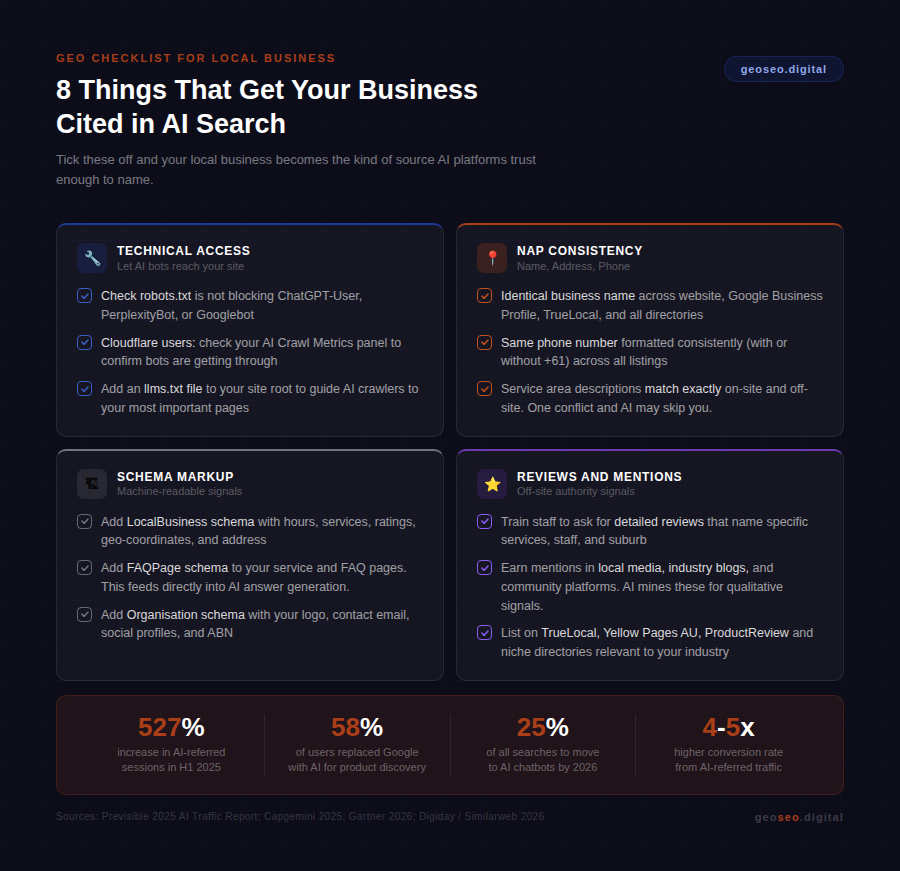
The 6 Things That Determine Whether AI Recommends Your Business
1. Your site is accessible to AI Crawlers
AI platforms use their own bots to retrieve content from the web. ChatGPT uses a bot called ChatGPT-User or GPTBot. Perplexity uses PerplexityBot. Google’s Googlebot feeds both traditional search and AI Overviews.
If your robots.txt file is blocking these bots, or your Cloudflare settings are rejecting them, AI platforms literally cannot read your site. They can’t recommend what they can’t access.
Start by checking your robots.txt file at yourdomain.com.au/robots.txt and confirming none of these crawlers are blocked. If you use Cloudflare, check your AI Crawl Metrics panel.
You should also consider adding an llms.txt file to your site root. This is a simple text file that tells AI crawlers which pages are most important and how your site is structured, helping them index you more accurately.
2. Your NAP details are consistent across the web
NAP stands for Name, Address, Phone number. AI search systems cross-check these details across your website, your Google Business Profile, and every directory or listing where your business appears. Any inconsistency, such as a slightly different business name, an old phone number on TrueLocal, or a different address on Yellow Pages, signals low trustworthiness.
This is one of the most common and easily fixed issues we see. Audit every place your business appears online and make sure the information is word-for-word identical.
For Australian businesses, the priority directories are: Google Business Profile, TrueLocal, Yellow Pages AU, ProductReview, and any industry-specific directories relevant to your trade or profession.
3. Your website uses structured data
Structured data, also called schema markup, is a layer of code that makes your content machine-readable. Instead of an AI having to guess what your business offers, schema tells it directly.
For local and service businesses, the three schema types that matter most are:
- LocalBusiness schema: includes your business name, address, phone, opening hours, service areas, geo-coordinates, and ratings.
- FAQPage schema: applied to your FAQ sections, this feeds directly into AI answer generation. When a user asks AI a question that matches your FAQ, there is a much higher chance of being cited.
- Organisation schema: includes your logo, contact email, social profiles, and ABN. This helps AI understand your entity and builds trust in your brand’s legitimacy.
You do not need to touch code to add schema. In WordPress, plugins like Rank Math or Yoast SEO handle most of it. In Squarespace or Wix, there are built-in or third-party options. If you are unsure, this is something an SEO or GEO professional can add in a single session.
4. Your content answers the questions customers actually ask AI
When someone uses AI to find a local service, they don’t type keywords. They ask full questions.
“What’s the best accountant for a small business in Brisbane?” or “Is there a physio in Fitzroy that bulk bills?”
Your website content needs to be written in a way that directly answers these kinds of questions. That means:
- Service pages that describe what you offer in plain language, not jargon
- A dedicated FAQ section that addresses the specific questions your customers ask at the point of discovery
- Location-specific pages if you serve multiple suburbs or regions, with real detail about the areas you serve (not thin, duplicated content)
- An About page written to answer “who is this business and why should I trust them?”, not just a bio
AI systems extract facts from content that is clear, structured, and specific. Vague or generic copy gets skipped.
5. Your reviews mention specifics
AI doesn’t just count your star rating. It reads the text of your reviews and extracts qualitative signals. Reviews that mention specific services, specific staff names, specific locations, and specific outcomes are the most useful to AI when constructing a recommendation.
Train your team to ask for detailed reviews, not just a five-star tap. A simple prompt to customers works well: “We would really appreciate a quick Google review. It helps a lot if you can mention the specific service we did for you and your suburb.”
The quantity of reviews still matters. So does recency. AI systems weigh fresh information more heavily, so a steady stream of new reviews is more valuable than a large number of old ones.
6. Your business is mentioned consistently off-site
AI citation authority is built not just by what’s on your website, but by where your brand appears across the broader web. Every mention of your business in a credible context, including without a link, contributes to what AI understands about your reputation and reach.
For local businesses, the most impactful off-site signals are:
- Google Business Profile (optimised and regularly updated)
- Directory listings with consistent NAP details
- Local media coverage and community mentions
- Industry association memberships and listing pages
- Responses to your reviews (AI reads these too)
This is a shift in thinking from traditional link building. You are no longer just trying to earn backlinks. You are building a consistent, credible presence across every platform where your name might appear.
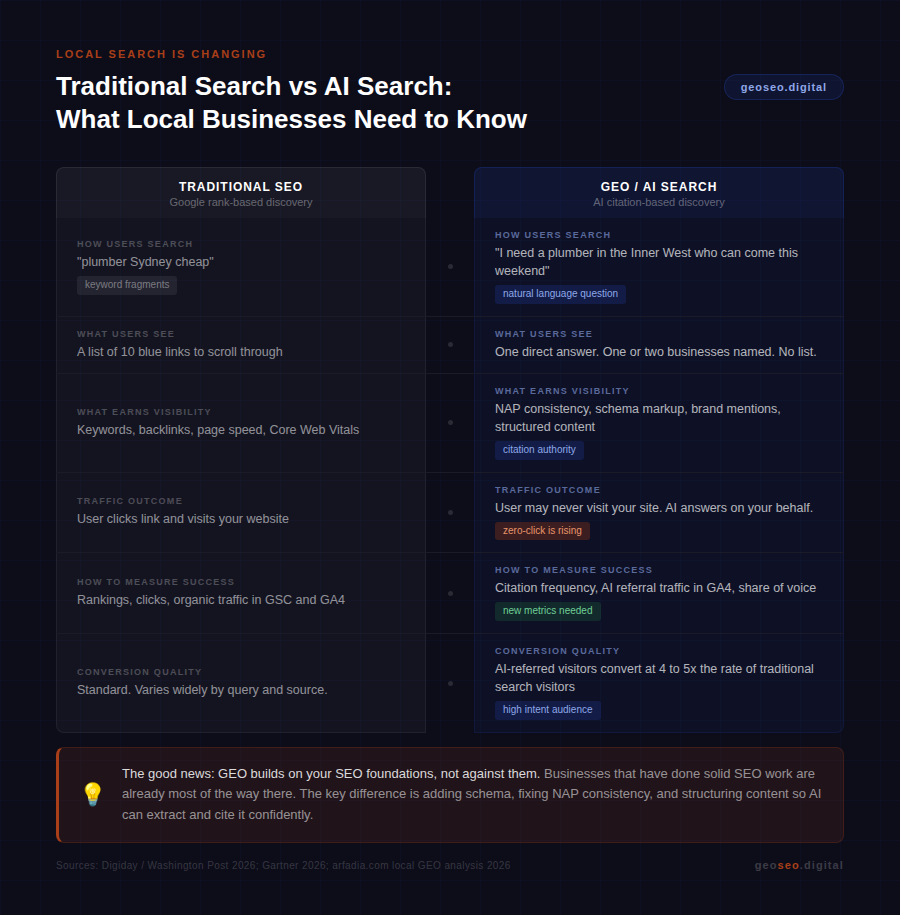
Traditional Search vs AI Search: What Actually Changes for Your Business
The comparison below captures the key differences at a practical level. Understanding this shift helps you prioritise what to work on first.
How to Start Measuring Your AI Search Visibility
One of the biggest challenges with GEO right now is that the measurement tools are still catching up. Traditional analytics tracks clicks and rankings. AI search often results in a brand mention without a click at all.
Here is what you can track without paying for specialist software.
Set up AI referral tracking in GA4. Google Analytics 4 allows you to filter traffic by source. AI-referred sessions appear as traffic from chatgpt.com, perplexity.ai, and similar domains. Set up a custom channel group or segment to monitor this. It takes less than 10 minutes and gives you a baseline to build from. This step-by-step guide from Two Octobers walks you through the process.
Manually query AI platforms with your target questions. Every month, open ChatGPT, Perplexity, and Google AI Mode. Type in the questions your ideal customers would ask. See whether your business appears, and if so, how it is described. Note which competitors show up when you don’t. This manual audit takes 20 to 30 minutes and tells you more than most paid tools.
Check your server logs for AI bot traffic. If you have access to your server logs or your Cloudflare dashboard, you can see whether AI crawlers are visiting your site. Look for ChatGPT-User, PerplexityBot, and other known AI user agents. If you’re not seeing any, that is a flag that your site may be blocking them.
Track brand mentions. Tools like Google Alerts (free) or Brand24 notify you when your business is mentioned online. While these do not directly track AI citations, the same mentions that appear on the open web are often the sources AI systems pull from.
For a more complete picture of your current AI visibility, a GEO audit will identify exactly what is working and what is holding you back.
The Practical Priority Order for Local Businesses
If you are starting from scratch, here is the order that will get you the fastest visible results.
- Fix technical access first. Check robots.txt and confirm AI bots are not being blocked. This is a prerequisite for everything else. If AI cannot read your site, nothing else matters.
- Audit and fix your NAP consistency. Search your business name on Google and look at every listing. Any inconsistency needs to be corrected. Focus on your Google Business Profile first, then TrueLocal, Yellow Pages AU, and your website footer.
- Add LocalBusiness and FAQPage schema. If you’re on WordPress, install RankMath or Yoast and follow their schema setup wizard. Add a proper FAQ section to your most important service pages.
- Rewrite your service pages to answer questions directly. Look at each service page and ask: “If a customer asked AI what [your service] in [your suburb] is like, would this page give a clear, confident answer?” If not, add specifics, add FAQs, add your service area detail.
- Start building your review strategy. Put a simple system in place to ask every satisfied customer for a specific, detailed Google review. Brief your team. Make it part of your post-job process. Several of our clients incentivises their team by paying them for every review they get, which helped get both plenty of reviews and new customers, quickly.
- Create or update your llms.txt file. This is a small time investment with a direct impact on how AI crawlers navigate your site. You can learn more in our guide to llms.txt files.
None of these steps require a big budget. They do require consistency and attention to detail.
The Takeaway
AI search is not replacing Google. It’s adding a new layer of discovery that sits on top of everything you’ve already built.
The businesses that show up in AI recommendations are not necessarily the largest or the most expensive. They are the ones whose information is consistent, accessible, structured, and credible across every place it appears online.
For local businesses, this genuinely levels the playing field. A well-run small business with clean data and a clear online presence can absolutely beat a larger competitor that has not paid attention to any of this.
The time to get ahead of it is now, while most of your competitors are still catching up.
Want to know where your business stands in AI search right now? We offer a free GEO and SEO audit that shows you exactly what AI platforms can and cannot see about your business, and what to prioritise to fix it.